Roughly 2,900 home clothes dryer fires are reported in the United States every year, according to the U.S. Fire Administration. The leading cause isn't faulty wiring or a defective machine. It's lint. Specifically, it's the failure to clean the dryer and the vent that carries hot, damp air out of the house.
That number tends to surprise people, because most of us think of the lint trap as the whole job. You pull off the fuzzy gray sheet after each load, toss it, and move on. But the lint screen only catches part of what your dryer produces. The rest gets blown into the duct behind the machine and slowly builds up along the walls, in the bends, and at the exterior flap.
If you've never had your dryer vent cleaned, or you can't remember the last time, this post is for you.
What Actually Happens Inside a Clogged Vent
A dryer works by heating air, pushing it through tumbling clothes, and exhausting the moisture outside. That only works when air can move freely. As lint coats the inside of the duct, the opening narrows. Less air escapes. Heat backs up toward the drum.
Now the dryer runs hotter and longer to do the same work. Lint is extremely flammable, and it's sitting right there in the path of that heat.
Even when nothing catches fire, a restricted vent costs you. Loads that used to take 45 minutes start taking 70 or 80. Your machine's heating element and thermal fuse work overtime. Moisture that should leave the house can condense inside the duct, which invites mildew and attracts even more lint.
Seven Signs Your Dryer Vent Needs Attention
You don't need a camera or special tools to spot a problem. Watch for these:
- Clothes are still damp after a full cycle. This is the most common first clue.
- The top of the dryer feels unusually hot during or right after a load.
- The laundry room gets warm and humid while the dryer runs.
- A burning or musty smell appears when the machine is on.
- The exterior vent flap barely opens, or doesn't open at all, while the dryer is running.
- Lint collects around the outside vent opening or on the ground beneath it.
- Birds or rodents have been spotted near the exterior vent. Nests are a surprisingly common blockage.
One sign by itself might be nothing. Two or three together usually mean the vent is overdue.
How Often Should Dryer Vent Cleaning Happen?
For most Harrisonburg households, once a year is a sensible baseline. Some homes need it more often:
- Large families running the dryer daily
- Homes with pets that shed heavily
- Laundry rooms in the center of the house, where the vent run is long and has several turns
- Older homes with flexible foil or vinyl ducting, which sags and traps lint
- Rental properties and student housing near JMU, where machines run constantly and nobody is keeping track
A good rule: if your vent run is longer than about 25 feet, or it goes up through the roof instead of straight out a wall, plan on more frequent checks. Roof vents in particular collect lint at the top where gravity works against you.
Why a DIY Brush Kit Often Falls Short
Hardware stores sell brush kits for dryer vents, and they can help with a short, straight run. The trouble is that most vents aren't short or straight. They snake through walls, crawl spaces, and attics. A brush pushed from one end can compact lint into a bend rather than remove it, and flexible ducts can tear or disconnect if you push too hard.
Professional dryer vent cleaning uses equipment designed to reach the full length of the line, loosen buildup at every turn, and pull it out instead of packing it further in. If you're weighing whether to hire help at all, here's why professional dryer vent cleaning is worth it. A technician will also check the exterior flap, look for crushed or disconnected sections behind the dryer, and let you know if your ducting material is a safety concern.
Check the Duct Material, Too
Take a look behind your dryer. If the hose connecting it to the wall is white vinyl or thin, crinkly foil that looks like a slinky, it's worth replacing. These materials crush easily when the dryer gets pushed back against the wall, and the ridges inside catch lint like a comb. Vinyl can also melt or burn.
Most dryer manufacturers call for rigid or semi-rigid metal ducting. Building codes also limit how long a dryer exhaust run can be. The International Residential Code, which Virginia's building code is based on, generally caps the run at 35 feet and subtracts length for every elbow: 5 feet for each 90-degree turn and 2.5 feet for each 45-degree turn. A vent that loops through a basement with four or five turns may be over that limit, which makes regular cleaning even more important.
You don't have to memorize any of this. A technician can tell you during a cleaning whether your setup is helping or hurting.
A Quick Note on Energy Costs
Dryers are one of the bigger energy users in most homes. When a clogged vent turns a one-cycle load into a two-cycle load, you're paying to run the heating element twice. Clearing the line won't make your dryer brand new, but many homeowners find that regular dryer vent cleaning trims drying times noticeably, and that adds up across hundreds of loads a year.
What to Expect From a Visit
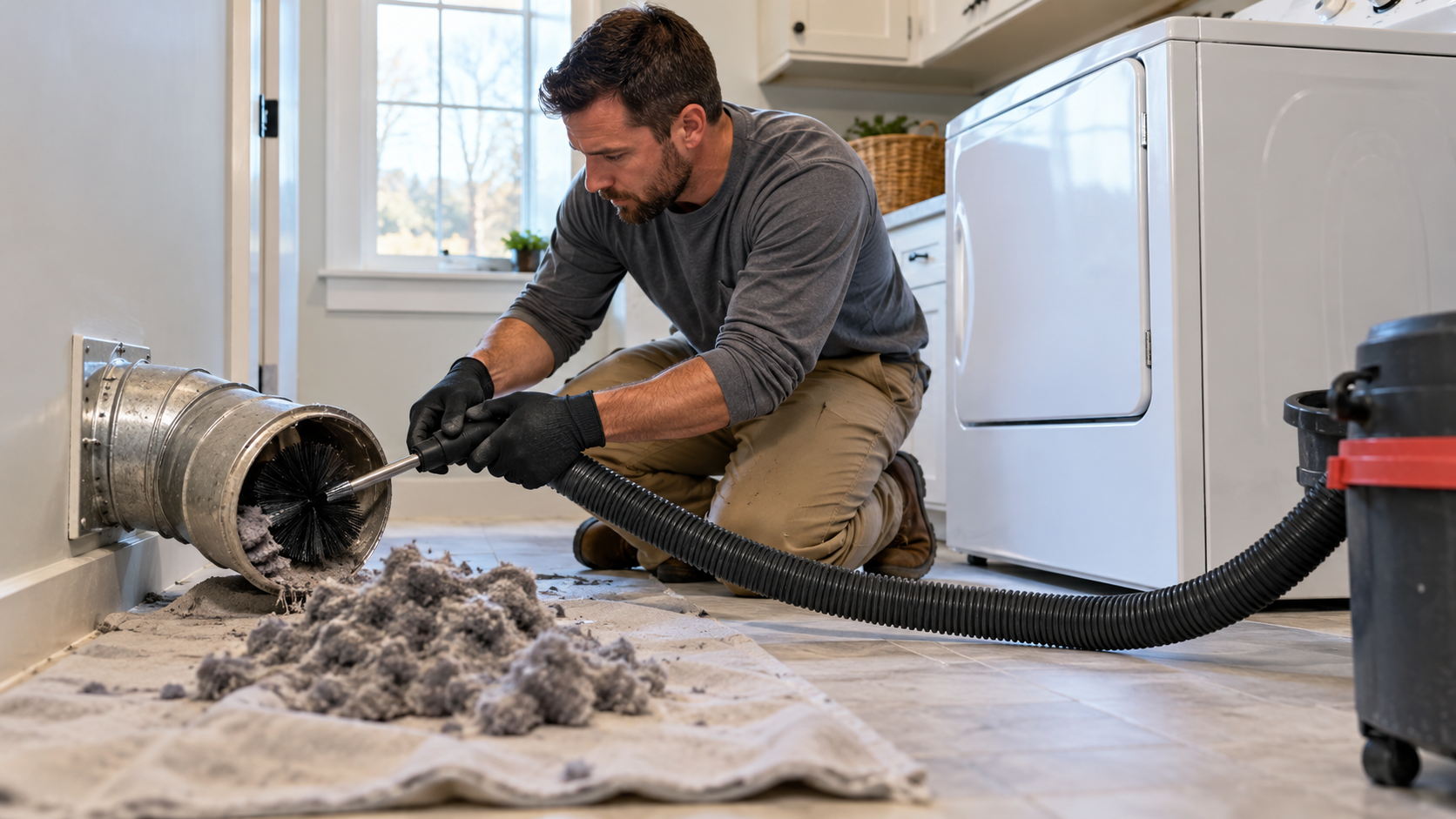
A typical residential dryer vent cleaning is quick and fairly low-key. The technician pulls the dryer out from the wall, disconnects it, and cleans the duct from inside and outside the house. They'll clear the transition hose behind the machine, clean the exterior hood, and reconnect everything. Afterward, they'll run the dryer to confirm strong airflow at the outside vent.
Most homeowners notice the difference on the very next load. Towels dry in one cycle again. The laundry room stops feeling like a sauna.
Common Questions About Dryer Vent Cleaning
Do gas dryers need their vents cleaned too? Yes, and arguably more so. A gas dryer burns fuel to make heat, and the exhaust carries combustion byproducts, including carbon monoxide, out of the house. A blocked vent can push those gases back into the laundry room. If you have a gas dryer, a working carbon monoxide detector nearby is a smart addition.
How long does a cleaning take? Most residential jobs are finished in about an hour. Long runs, roof terminations, or vents that need repairs can take longer.
Will it make a mess? It shouldn't. Lint is collected as it comes out of the line, and the area around the dryer is cleaned up before the technician leaves. You may be surprised by how much comes out, though. It's common to see a full bag of lint from a vent that hasn't been touched in a few years.
Is a stackable or closet dryer different? Stacked units and dryers tucked into tight closets often have very short, sharply bent connections behind them, which crush easily. They're worth checking more often, especially in apartments and townhomes.
Should I clean the lint trap with water? Every few months, yes. Fabric softener sheets can leave a waxy film on the screen that blocks airflow even when it looks clean. Scrub it gently with warm, soapy water and an old toothbrush, then let it dry completely before putting it back.
Local Help in the Valley
Spotless Specialty Cleaning & Restoration has been serving Harrisonburg and the surrounding Valley since 2011. Dryer vent cleaning is one of the simplest, most affordable ways to protect your home, and it pairs well with duct cleaning if you're already planning indoor air work.
If your clothes are taking longer to dry, or you just can't remember the last time someone looked behind the machine, give us a call at 540-434-1292. It's a small job that removes a real risk.